

The 8-Minute Guide to Opening Up
Practical, non-prescriptive thoughts on conversations, timing, boundaries, and jealousy.

Fifteen years ago, a friend of Rich’s—the only polyamorous person we knew at the time—sent us an email. It was a simple, bullet-pointed list of recommendations for opening our relationship. The list came from a woman I had never met. But she had been in a polyamorous relationship for two years. And back then, that was enough to make her an expert in our eyes.
I looked in my inbox and, sure enough, the email is still there. Some of her advice still holds up. Some of it feels dated. But what stood out most was this: it was addressed to Rich. Advice for him.
So I took a step back. What would my version look like? What would I send to a couple who emailed me today asking the same question he asked all those years ago: How do we explore an open relationship together?
Here it is.

The initial conversation is scary. If social media comments are anything to go by, a lot of people fear that the moment they bring up the idea of an open relationship, their partner will look them up and down, storm out, and end the relationship on the spot. Game over. In my experience, that’s social media reality, not real life.
The first conversation is often messy, emotional, and uncomfortable, even when it’s rooted in love. And that’s okay. Wanting to change or adapt a relationship doesn’t mean it’s broken. But it might go more smoothly if you start with why.
1) Start with your why, not the solution.
Before you say anything to your partner, pause and ask yourself one question: Why?
Not why non-monogamy in theory. Why you. Why now.
Are you craving novelty? Feeling boxed in? Curious about your sexuality? Wanting more connection? Feeling a pull toward someone else? Sitting with a truth you haven’t said out loud yet?
Start there.
When you lead with “I want an open relationship,” you’re leading with a solution. When you lead with “I’ve been feeling…”, you’re inviting collaboration. A want, desire, or challenge where both partners are part of the solution. Together.
👉 Watch + read more: How to Have the Initial Conversation
2) Go at the speed of the slowest person.
There is no universal timeline for opening a relationship. I’ve spoken to many couples who feel like they need to change their relationship from monogamous to polyamorous overnight, as if there’s a switch you flip and suddenly you’re “doing it right.”
Some couples open early. Some take years. Some never do. Some start with swinging. My husband used to say that we could choose to be open on the first Tuesday of months that start with the letter “J”. I don’t actually recommend that, but his point was this: we decide our timing.
I teach skiing, so forgive me for how often I associate learning new things with skiing. The best thing for the group in the long term is to move at the speed of the slowest person. It’s the only way everyone stays upright and learning. Relationships work the same way. If one partner is sprinting and the other is bracing, resentment builds fast.
👉 Watch + read more: Timing
3) Think in phases, not leaps.
Opening up doesn’t have to be all-or-nothing. In fact, it usually works better when it’s not. Think in phases:
Phase 1: What feels doable now
Future phases: What might be possible later
Everything you’re not ready for yet goes into the future column. Not to ignore it. Just to stop negotiating it endlessly in the present. That alone lowers anxiety dramatically.
Phase 1 might include flirting. Or dating apps. Or just conversations. It might last two weeks or two years. You decide.
What matters is agreeing on:
What’s allowed now
When you check in again
What needs to feel true before moving forward
👉 Watch + read more: Phases

4) Communicate early, and more than feels necessary.
Every couple I’ve talked to that opened up says the same thing in hindsight: “We should have communicated more.” Communication in non-monogamy isn’t about being perfect. It’s about being honest early, before emotions harden.
I wrote recently about practicing more gratitude in 2026. This is one of those places where I fail loudly. I almost always start conversations with what I want to change or optimize, not what I’m grateful for. Drives. My Husband. Nuts.
One framework I (ahem, try to) use is Have / Need / Want:
What do I already have in this relationship?
What do I truly need to feel okay?
What do I want that would add something extra, but isn’t essential?
It’s a Danielle original. It’s not perfect. There are many wiser people out there who have more and better communication tools. Here are a few:
“This is important to me” — a way to signal emotional weight
Spotlight — one person speaks, the other listens
Parroting — repeating back what you heard before responding
Pause buttons — permission to slow things down when it’s too much
The goal isn’t perfect communication. The goal is trust.
👉 Watch + read more: Communication
5) Know the difference between boundaries and rules.
They are not, in fact, the same thing. Even though they are often used interchangeably. Here’s a simple distinction:
Boundaries are personal limits you set for yourself.
Rules are agreements you make together.
For example, a couple might agree on a rule that they always have protected sex with other partners. A boundary, on the other hand, could be that if one partner has unprotected sex, the other partner will choose not to have sex with them until testing has happened. One is an agreement. The other is something a person can uphold on their own (assuming, of course, their partner doesn’t lie).
And that assumption matters. Boundaries only work when honesty exists. Without it, no amount of rules will create safety.
When thinking through boundaries and rules, I like to run them through five lenses:
Who
What
Where
When
Why (for each of the above)
The why matters more than people think. It’s what turns rules from control into care.
Rules often emerge in areas where partners’ individual boundaries overlap, especially around finances, sexual health, privacy, and time. When two people care about the same limits, it makes sense to turn those shared concerns into agreements. And yes, those rules can change. That doesn’t mean you failed. It usually means you’re entering a new phase of the relationship.
👉 Watch + read more: Boundaries & Rules
6) Treat jealousy as information, not failure.
Jealousy isn’t a sign you’re doing this wrong. It’s a signal that something feels at risk.
When jealousy shows up:
Name it.
Breathe.
Ask why. Then ask why again.
Translate jealousy into a solvable need.
“I’m jealous” is a feeling.
“I need more reassurance and time with you” is actionable.
You may also hear about compersion—feeling joy for your partner’s joy. You might feel it. You might not. Here’s a not-well-kept secret: I rarely, rarely experience compersion.
There’s no gold star for performing the “right” emotion. Honesty beats telling someone what you think they want to hear every time.
👉 Watch + read more: Managing Big Emotions
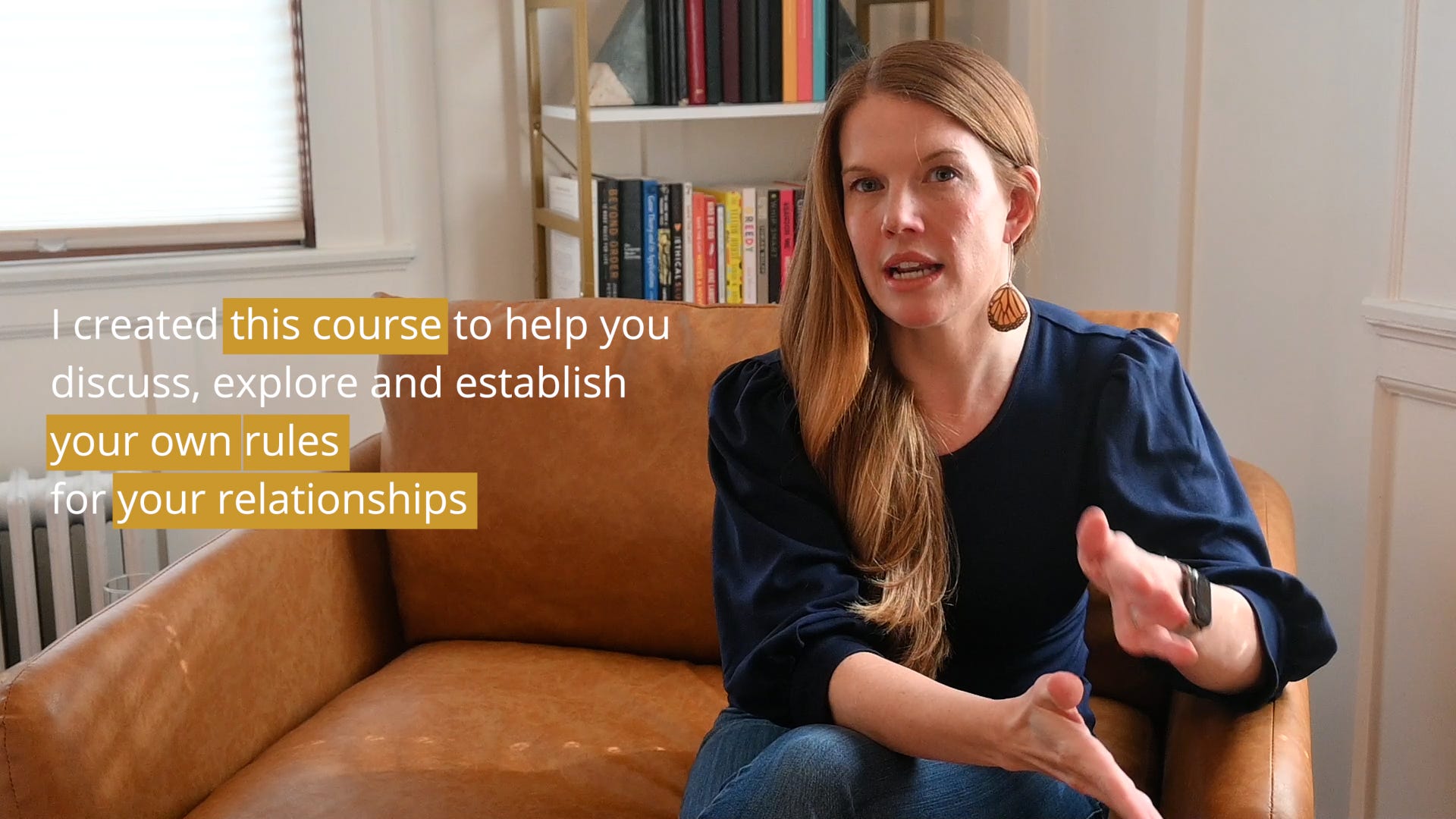
Final Thoughts
Opening a relationship won’t fix what’s broken, but it can deepen a relationship.
Things won’t always feel equal. They don’t need to. Balance often shows up over years, not weeks. My husband and I have almost never both been dating the same amount at the same time. Maybe more on that in a future post.
Most importantly: no one else gets to decide how you love. Not culture. Not tradition. Not the internet. Not me.
Take what’s useful. Leave what isn’t. If you want to go deeper, each section above links to a full Substack post and video. And if you’re somewhere in the middle of this and feeling lost, you’re not alone. I promise. I’ve been there too.
This is very helpful! I’m in this spot right now and will definitely explore some of these concepts with my hubby.
Outstanding summary and field guide for developing and sustaining meaningful relationships (with one 's own self and any number of others ).
I wish I had read and learned and lived this starting 69 years ago. SWOK SWOH SWOW (kiss and hug and whatever is mutually agreed upon).